You have a great product. Real clients are buying it. You’ve achieved what almost nobody does: actual market fit. According to US Census Bureau data, fewer than 4% of US businesses ever reach seven figures in annual revenue. By any measure, you’re already wildly successful.
Look at what you’ve built. Double-digit headcount growth year over year. Profit. A nice office. A team you’re proud of. You proved to the world that your idea makes business sense. You thought that was the ultimate milestone.
Then the costs started piling up. The tools got more expensive. The consultants got more expensive. The people got more expensive. And somehow, with all of that investment, everything started moving slower. Which makes no sense. When you add people to the payroll, you should get faster. Instead you feel like you’re swimming in wet concrete.
Engagement is dropping in parts of the team. You’re making recruitment mistakes you never used to make because you can’t interview every candidate anymore. You used to know what everyone was working on. Now you don’t know the names of some of the people on your payroll.
Your best people are stretched thin. One of them has threatened to leave. The three who always knew what to do are now the three who are always at capacity.
Your clients are using your team’s performance against you at renewal. They weaponize it. Better pricing in exchange for not escalating. You’re being pulled into conversations you should never be in. Your people call you when it gets hard instead of handling it themselves. You end up working for them instead of the other way around.
Nothing is documented. Everyone complains there’s no manual. Some people are burned out. Others are having coffee. You’re accomplishing less with a bigger team, a better office, and more software than you’ve ever had.
And somewhere in the back of your mind is the number. Eighty percent of your revenue from twenty percent of your clients. You know what happens if you lose one of the big ones.
You solved the hardest problem, which was finding clients. You assumed the rest would follow. It didn’t.
There’s a silent shift that happens at this stage of a company’s life cycle. The informal coordination that got you here stops working. It doesn’t bend. It breaks. And the business growth strategies that carried you to this point won’t be sufficient to carry you forward. In fact, if you don’t change anything, they’ll be the sole reason for your demise. Instinct was never designed to scale.
The Mistake Every Growing Business Makes
When the first difficulties arrive, the instinct is to reach for a tool.
This makes sense. Back in the startup days, you never had the budget for proper enterprise-grade software. Now you do. So you buy it. Project management platforms. CRMs. Automation tools. Dashboards. The ones you always wanted and could never afford. They don’t work, and here’s why. A tool is a multiplier. If you have a well-designed process, a tool makes it faster and more consistent. If you have a poorly designed process, a tool makes the chaos faster and more consistent. You don’t add a GPS to a broken car and expect to arrive somewhere useful. If you add a tool to madness, you get faster madness.
So once the tools disappoint, the next instinct is people. Your colleagues are saying they’re burned out and overworked. Natural solution: bring in more people. More hands, more capacity, problem solved. Except it isn’t.
More people means more coordination. It also dilutes quality. You can’t sustainably hire A players at volume. The more people you add, a certain percentage won’t be top performers. That’s not a failure of judgment. That’s mathematics. And now you need a capable middle layer to manage them, which is pure overhead, and most founders aren’t experts in management or organizational structure. So the setup is suboptimal from day one.
You’re in your most vulnerable stage right now. Between three and ten million dollars, the overhead is real and the growth is real, but the infrastructure underneath it is still early-stage. Most founders look at this and reach for more people. But the gap isn’t in the quality of your team. It’s in the structure your team is operating inside.
Most founders never make this distinction because nobody gave them the vocabulary for it. They were taught to hire well, motivate well, manage well. They weren’t taught to think about the structure that all those people are operating inside. So they keep hiring. They keep reorganizing. They keep solving the same problem on a bigger and more expensive stage.
The reason this misdiagnosis is so persistent is that architectural problems are invisible until they’re catastrophic. A people problem shows up immediately: someone underperforms and you can see it. An architectural problem builds silently for months. Everything looks like it’s working until suddenly the whole system grinds. By the time the founder notices, they’ve already spent a year and a significant amount of money on the wrong fix.
Here Is What Is Actually Going On
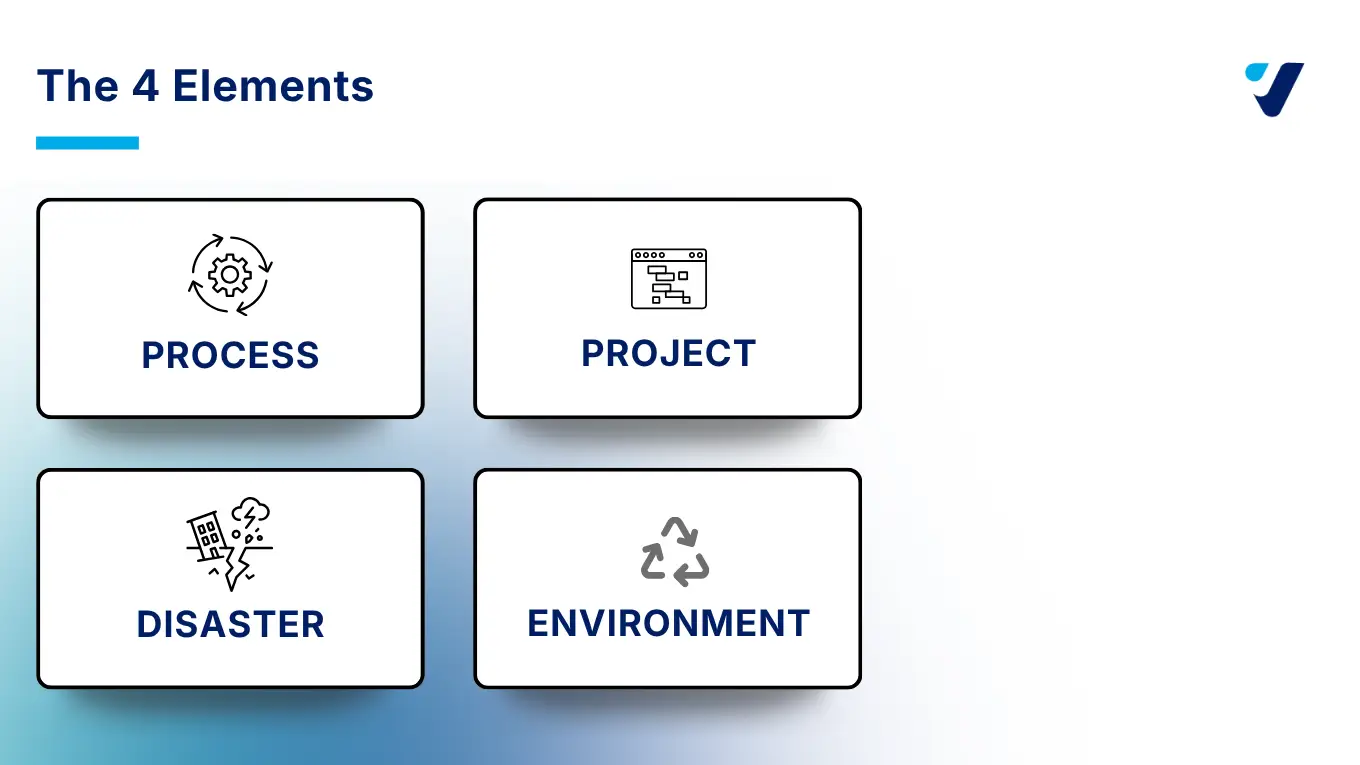
Strip away the org chart, the brand, the product, the sales deck. Underneath all of it, every business is made of four fundamental elements.
 {width=1360 height=765}
Projects. Temporary efforts with a defined start, a defined end, and a specific outcome. Building a new service. Onboarding a new client. Launching a new market. Projects are one-time events. They require adaptability, decision-making under pressure, and tolerance for uncertainty.
Processes. Ongoing, repeatable activities where the goal is consistency. Invoicing. Reporting. Monthly client updates. Processes are the opposite of projects. They require precision and repetition. Put a process person on a project and they’ll ask for a manual that doesn’t exist. Put a project person on a process and they’ll invent variation where none should exist. Wrong tool, wrong environment.
Disasters. They’re coming. The only variable is how fast you recover when they do. Every business at this stage is one bad quarter, one lost client, or one key resignation away from a genuine crisis. Most businesses discover too late that they weren’t built to absorb one without everything else stopping too.
Environment. This is the context everything else sits inside. Market conditions, team morale, client relationships, economic pressure. Most businesses pay attention to the environment only after it’s already shifted against them. By then they’re reacting rather than reading. Staying close to what’s changing around the business isn’t optional. It’s how you see the next problem while there’s still time to act.
Most businesses in the three to ten million dollar range have no clear distinction between these four elements. They treat projects like processes. They treat disasters like projects. They put process-oriented people in project roles and wonder why everything takes twice as long.
There’s also a timing problem that compounds this. Every stage of company growth shifts the balance between these four elements. At startup, almost everything is a project. You have no processes yet. You’re figuring it out in real time. At the three to ten million stage, you have some processes, but the environment is still heavily project-based. If you hire people from large corporations - people who are wired for process and structure and clear manuals - they’ll be inefficient and you’ll almost certainly end up letting them go. It’s not their fault. It’s an environment mismatch.
Understanding which of these four elements dominates your current stage is one of the most practical hiring decisions you can make. Get it wrong and you’ll blame the person. The problem was the environment you placed them in.
What Business Growth Strategies Actually Work at This Stage
The founders who navigate this stage well eventually stop asking who they need to hire and start asking what their team is operating inside. That shift in framing is usually what changes things.
Separate your projects from your processes. Explicitly. By name. By person. By resource allocation. A growing business that can’t tell you which of its activities are projects and which are processes is running with four people who all think they’re steering. Someone is always overcorrecting.
Protect your value delivery chain. Every business has a core sequence of activities that produces the thing clients actually pay for. That chain isn’t one process among many. It’s the process from which everything else derives its purpose. When that chain breaks, revenue breaks and business performance collapses with it. Protect it with everything you have. When you have to choose between that chain and anything else, the chain wins. Every time.
Build for the stage you’re at now, not the stage you came from. The systems that worked at one million dollars are actively harmful at five million. The team that was perfect at ten people needs different management at thirty. Founders who scale well understand that every stage of growth obsoletes the previous set of solutions. What got you here won’t get you there.
Give your team a methodology, not just a direction. The highest-leverage investment at this stage isn’t another senior hire who arrives with a different set of working instructions and a fresh set of personality clashes. It’s building the delivery infrastructure that makes your current team perform at a level you previously thought required better people. A system that can be taught to anyone is worth more than a team of A players who carry the knowledge in their heads.
What This Looks Like in Practice
Finrelay is a fintech company with a payment gateway product that holds multiple patents and serves clients who have serious, specific demands. Excellent product. Real market demand. The kind of business that looks like it has everything figured out from the outside.
The problem was implementation time. Each client engagement was taking twelve months. The industry average was lower. The team was stretched and burned. Early clients were frustrated. The standard diagnostic pointed at people, but that wasn’t the problem.
The real issue was the absence of a requirements documentation and scope control framework. The engineers who built the product were also implementing it for each new client, from scratch, every time. No standard sequence. No documented requirements. Every engagement reinventing what the last one had already solved.
We ran a discovery workshop, identified the key leverage areas, and put the framework in place. Implementation time dropped from twelve months to six. By limiting the touch points between teams and introducing regular structured calls, client escalations dropped by half. We then built a standard implementation manual and a checklist precise enough that a newly joined implementation manager could run a standalone engagement without hand-holding.
Cubeia is an iGaming company running a B2B online betting platform with crypto capability. When we first looked at their numbers, one figure stood out: agreed onboarding time was six weeks, actual onboarding time was running up to six months. Consistently. Across every new client. The team was experienced, the product was genuinely sophisticated, and the market was moving fast, but none of that explained a four-fold overrun on every single engagement.
The cause was structural. There was no standardized onboarding sequence, no clear ownership of the process, and escalations landing wherever they could find a surface. We introduced a structured onboarding methodology. Escalations dropped by half. Capacity for new client onboarding increased by almost fifty percent. Nothing about the business changed except how the work was organised.
The details vary by industry and company size. If you want to work through what this looks like in your specific situation, book a free thirty-minute discovery call. No pitch. No deck. Just a direct conversation about what’s actually happening in your business and what it would take to fix it.